
Project overview
Intended market
Ghanaian viewers, creators, businesses and communities, with additional relevance to the Ghanaian diaspora and organizations seeking a Ghana-focused video and creator platform.
Engineering responsibility
Product architecture and Ghana-first platform design React/TypeScript frontend engineering and responsive PWA implementation Node.js/Express REST API and serverless backend architecture Authentication, JWT/JWKS verification and role-based access-control design Creator Studio and private Admin Back Office implementation Adaptive HLS video-delivery and Data Saver architecture Ghana 16-region discovery and configuration model Moderation, KYC, subscriptions, advertising and payout workflow architecture Vercel deployment, GitHub source control and environment configuration Production-readiness planning for Supabase, Cloudflare Stream, Paystack and OpenAI integrations
Problem or opportunity
Ghanaian creators, viewers, businesses and communities need a video platform designed around local content discovery, regional relevance, mobile-data constraints and creator workflows rather than a generic global-first experience.
Objectives
- Deliver a Ghana-first video-sharing and creator experience rather than a generic global-first interface.
- Support content discovery across all 16 Ghana regions with region-aware browsing and configuration.
- Reduce bandwidth pressure through adaptive streaming and a dedicated 360p Data Saver mode.
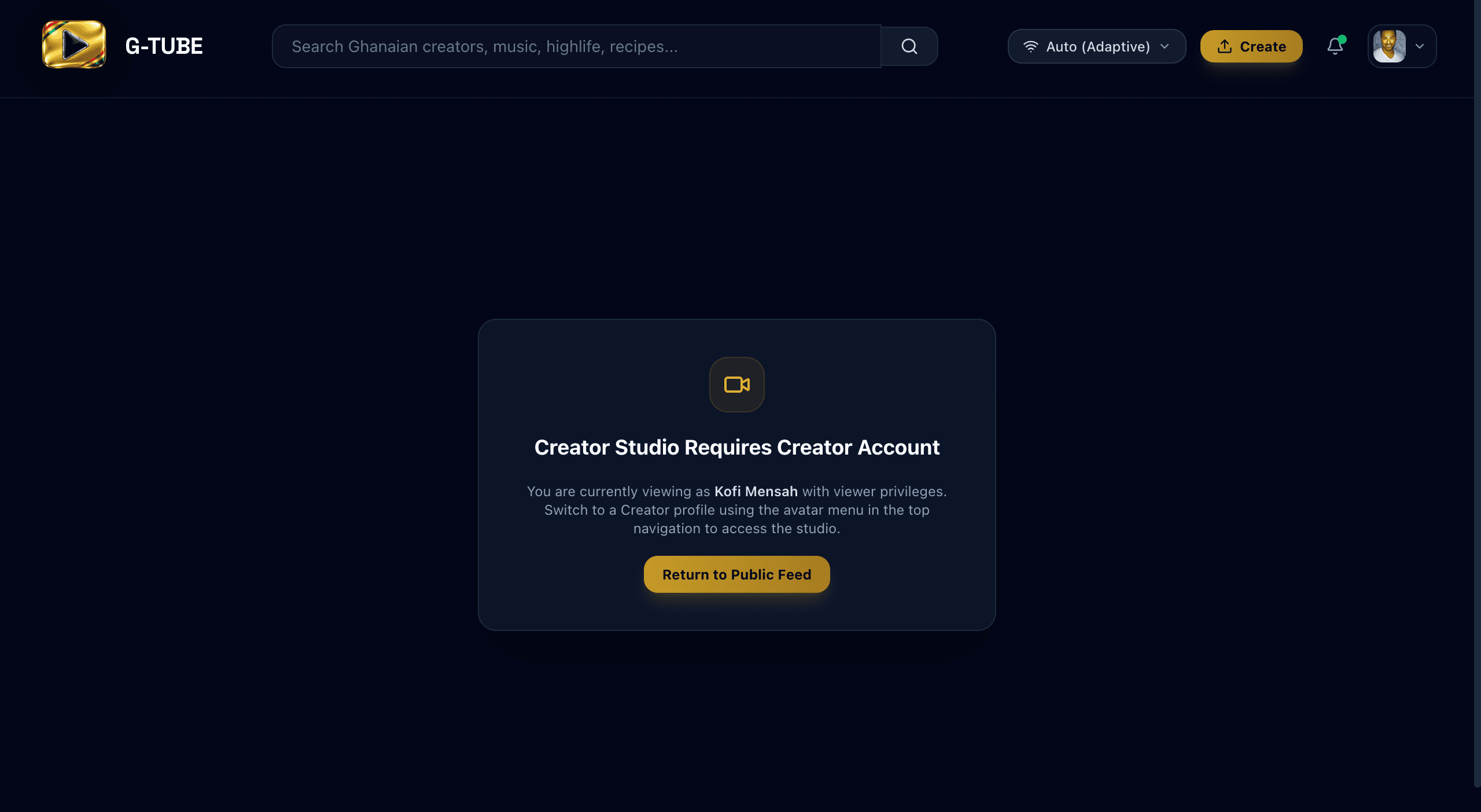
- Provide complete creator workflows through Creator Studio while keeping platform administration private and role-protected.
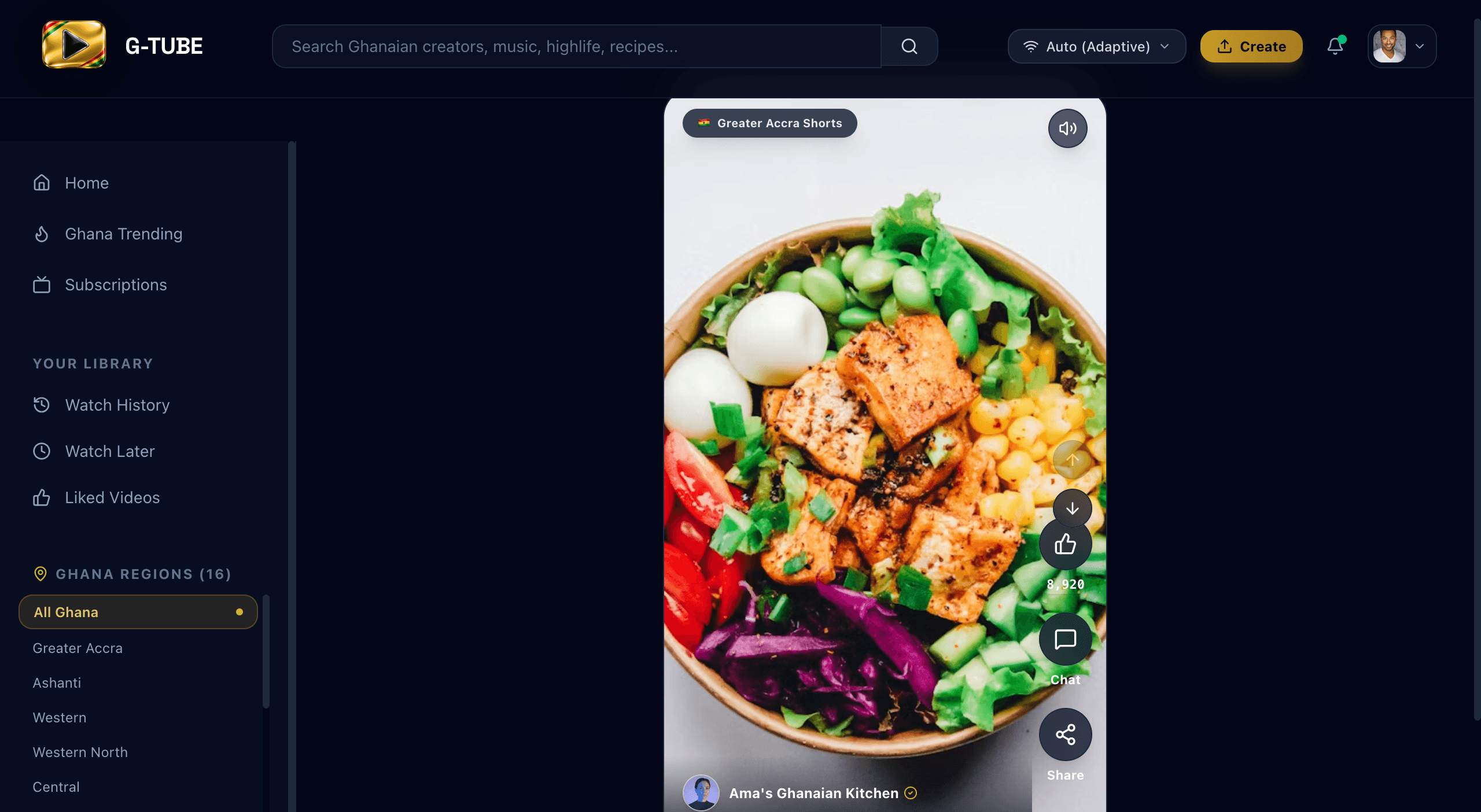
- Support Shorts-style vertical video, subscriptions, personal libraries, moderation and community interaction.
- Prepare production integrations for PostgreSQL/Supabase, Cloudflare Stream, Paystack and OpenAI without misrepresenting unconnected services as live.
Challenges and constraints
- Design adaptive video delivery for bandwidth-sensitive and mobile-first viewing, including a 360p Data Saver mode and multi-rendition HLS architecture.
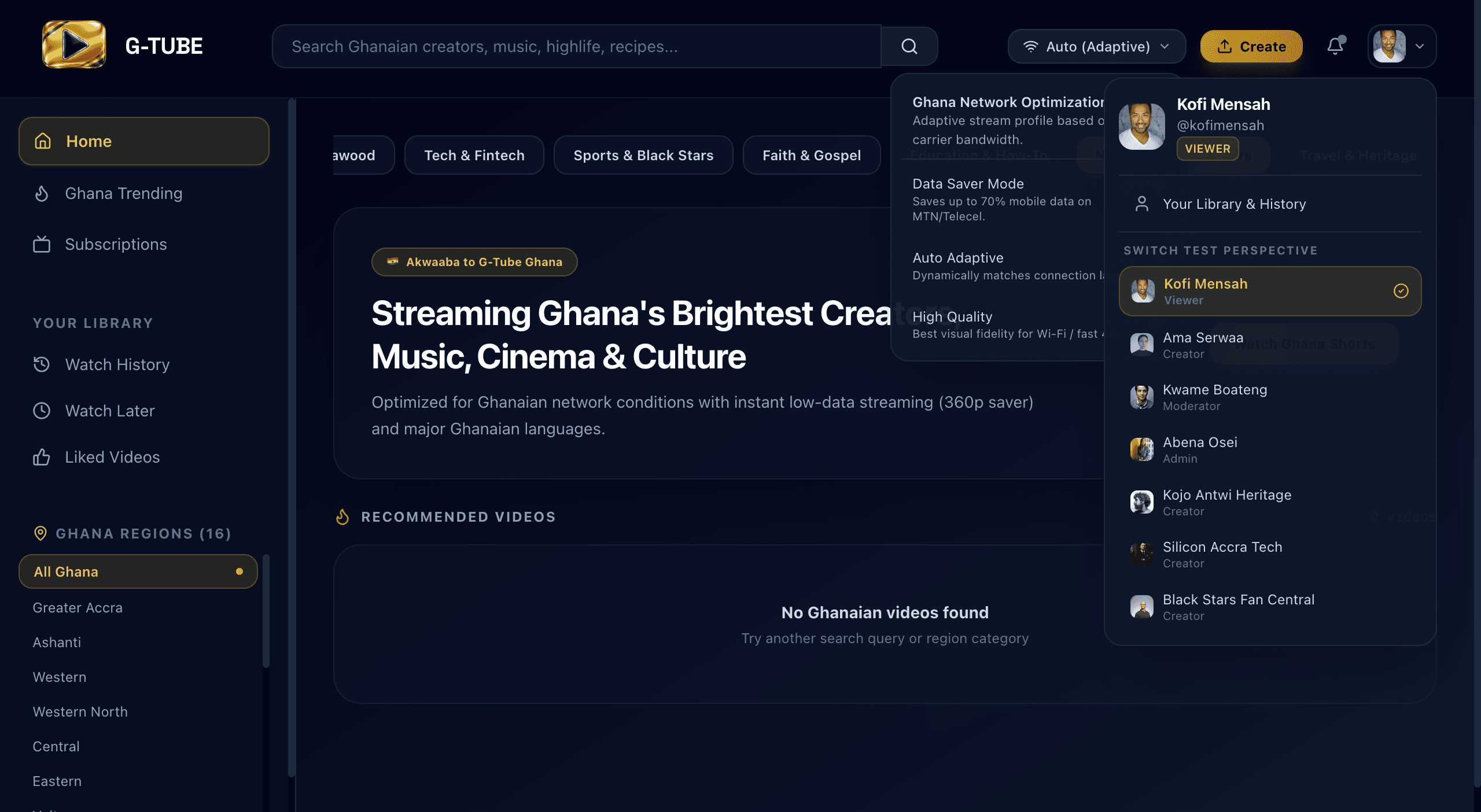
- Separate public viewer, Creator Studio and private Admin Back Office surfaces while enforcing server-side role-based access control.
- Model Ghana-specific discovery across all 16 administrative regions without presenting simulated infrastructure as live production telemetry.
- Support secure authentication, JWT/JWKS verification, administrator session security and private KYC document access.
- Prepare durable PostgreSQL/Supabase persistence and Cloudflare Stream integration while keeping unavailable production services clearly distinguished from staging/demo behavior.
- Build creator monetization, subscriptions, advertising and payout architecture without hardcoding unapproved commercial policies or fabricating live transactions.
Engineering approach
G-Tube is being developed as a modular full-stack platform with a React/TypeScript PWA frontend, Node.js/Express REST APIs, role-aware application shells, a dedicated private Admin Back Office, and provider-ready integration layers for authentication, persistent storage, adaptive streaming, billing and AI. The implementation prioritizes mobile-first usability, Ghana-specific discovery, low-data playback, explicit staging/production boundaries and server-side authorization.
Architecture
Architecture narrative
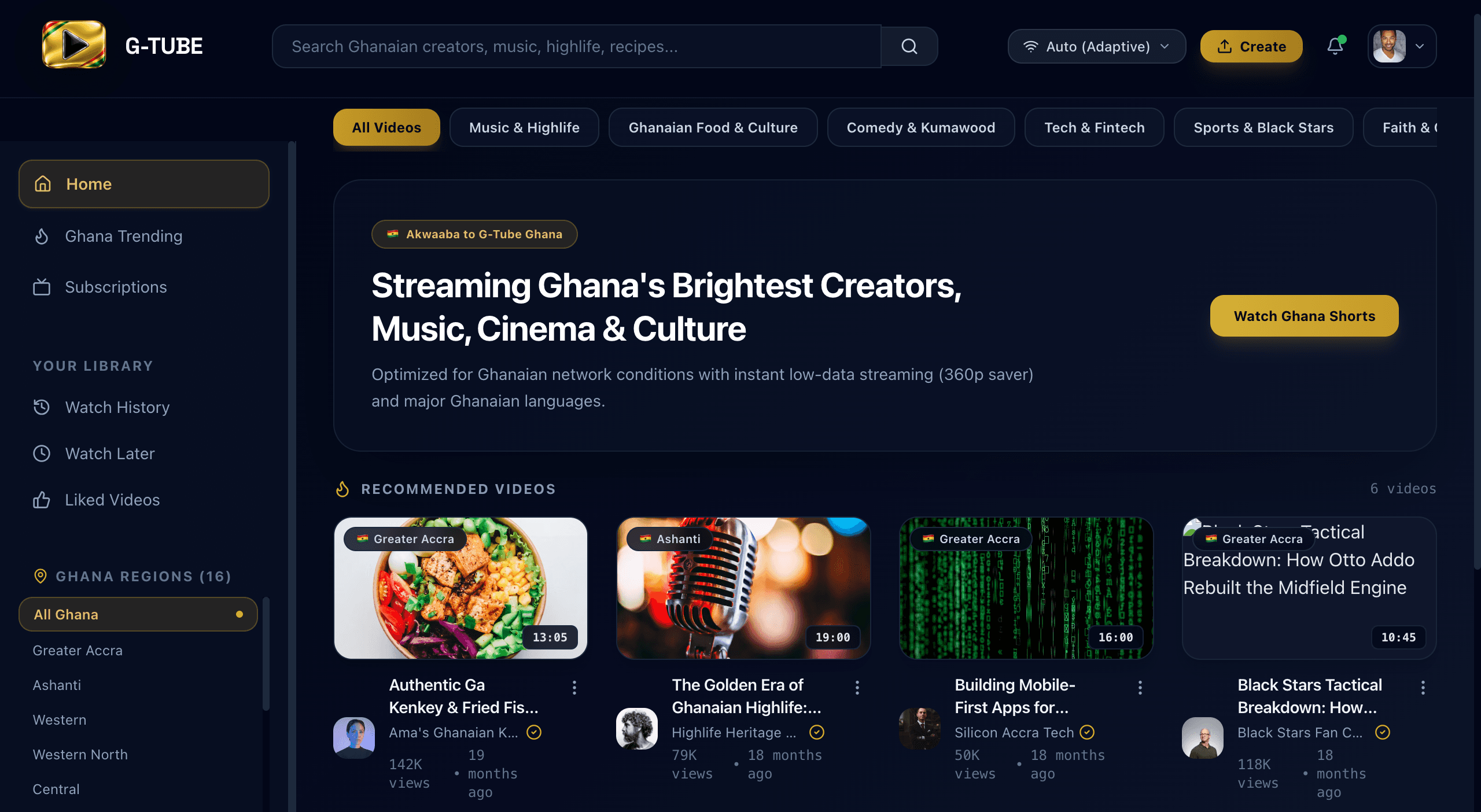
The current architecture separates the public viewer application, Creator Studio and private Admin Back Office. The frontend is built with React, TypeScript, Vite and Tailwind CSS. Express-based REST APIs are bundled for Vercel Serverless Functions. PostgreSQL/Supabase is the intended durable persistence and authentication layer. Cloudflare Stream is the intended production video-ingestion, transcoding and HLS-delivery provider. Paystack is the intended billing integration. GitHub is the source-control and deployment source for Vercel.
frontend
React 19 + TypeScript + Vite + Tailwind CSS 4 + PWA/service-worker support
backend
Node.js + Express 4 + TypeScript REST API bundled with esbuild for Vercel Serverless Functions
database
PostgreSQL with Supabase-ready persistence and authentication architecture
infrastructure
Vercel hosting/serverless deployment with GitHub-based source control and deployment workflow
services
Cloudflare Stream integration-ready video pipeline; Paystack integration-ready billing; OpenAI planned for approved AI features
integrations
JWT/JWKS authentication, RBAC, signed private-document access, HLS adaptive streaming, feature flags and webhook-ready provider integrations
Engineering decisions
Separate public, creator and administrator interfaces
Reason: Platform operators require privileged controls that must not be exposed in the normal viewer UI.
Engineering benefit: Clearer product boundaries and stronger authorization posture.
Use adaptive HLS with a dedicated 360p Data Saver mode
Reason: G-Tube is designed for mobile-first use where bandwidth cost and network variability matter.
Engineering benefit: Allows lower-bandwidth playback while preserving higher-quality renditions where available.
Use server-side RBAC for privileged operations
Reason: Frontend visibility rules alone are insufficient for administration and moderation security.
Engineering benefit: Administrative actions are enforced at the API boundary.
Keep provider integrations behind explicit configuration and feature flags
Reason: Production services such as Supabase, Cloudflare Stream, Paystack and AI must not be represented as live until credentials and end-to-end validation exist.
Engineering benefit: Prevents demo or staging behavior from being confused with production readiness.
Use Vercel serverless deployment with bundled Express APIs
Reason: The platform is currently deployed and tested through Vercel while retaining a conventional REST backend architecture.
Engineering benefit: Supports rapid staging deployment without rebuilding the frontend architecture.
Keep commercial rules configurable rather than hardcoded
Reason: Revenue share, plans, payouts and acquisition terms are owner-controlled business decisions.
Engineering benefit: Avoids embedding unapproved commercial policy in application code or UI.
Core capabilities
- Video uploading
- Online video streaming
- Creator channels
- User accounts
- Video discovery
- Content search
- Video categories
- Creator profiles
- Channel subscriptions
- Likes and reactions
- Viewer comments
- Video sharing
- Trending content
- Recommended videos
- Watch history
- Creator content management
- Video thumbnails
- Audience engagement
- Ghana-focused content discovery
- Mobile-responsive video platform
Challenge, response, outcome
Mobile data cost and variable network quality
Response: Adaptive multi-rendition HLS architecture with a 360p Data Saver option and mobile-first playback controls.
Verified outcome: A platform design that can prioritize lower-bandwidth viewing when required; production streaming remains dependent on the final connected video provider.
Ghana-specific discovery on a global-style video platform
Response: 16-region filtering, Ghana-focused categories and regional configuration for discovery and content weighting.
Verified outcome: The information architecture is centered on Ghanaian content, creators and regional relevance.
Privileged administration mixed with public navigation
Response: A dedicated /admin back-office shell with separate authentication and server-side role checks.
Verified outcome: Administrative workflows are structurally separated from the normal viewer and creator interfaces.
Staging data being mistaken for live production telemetry
Response: Explicit staging/demo labeling and provider-connected states are required before operational metrics are treated as real.
Verified outcome: The platform architecture distinguishes implemented UI/workflows from production-connected services.
Commercial features require owner-controlled policy
Response: Subscription, billing, payout and revenue-share structures are modeled as configurable settings rather than fixed business rules.
Verified outcome: Commercial configuration can be adapted without hardcoding unsupported assumptions.
Security and reliability
- Private Admin Back Office separated from public and creator-facing interfaces.
- Server-side role-based access control for privileged administrative and moderation endpoints.
- JWT/JWKS authentication architecture for production Supabase sessions.
- Administrative session signing requires configured server-side secrets and is designed to fail closed when required secrets are absent.
- Signed access architecture for private KYC documents; durable production storage remains a production integration task.
- Development persona switching is restricted to explicit local development conditions and must not provide production admin authority.
- Feature flags keep monetization, automated KYC, advanced transcription, advertising and optional AI capabilities disabled until deliberately enabled and configured.
Performance and scalability
The frontend is built as a responsive Vite/React application and the API layer is bundled for Vercel serverless deployment. The video architecture is designed around adaptive HLS renditions and a 360p Data Saver mode to reduce unnecessary bandwidth. Durable production scalability depends on the planned managed PostgreSQL/Supabase database and Cloudflare Stream integration; no unverified production throughput, latency or CDN-performance figures are claimed.
User experience
The interface is designed for Ghanaian viewers and creators across desktop and mobile. It includes a Ghana-focused home feed, regional filtering across all 16 regions, Shorts-style vertical viewing, subscriptions, personal libraries, creator channels, Creator Studio, responsive navigation and data-conscious playback controls. The Admin Back Office is intentionally separated from the public product experience.
Technology architecture
backend
Node.js · Express 4 · TypeScript · REST API · Vercel Serverless Functions · esbuild
frontend
React 19 · TypeScript 5.8 · Vite 6 · Tailwind CSS 4 · Lucide React · Motion · PWA
deployment
Vercel · GitHub · Vercel Serverless Functions
database_and_auth
PostgreSQL · Supabase-ready PostgreSQL · Supabase Auth/JWKS architecture · JWT · RBAC
video_and_streaming
Cloudflare Stream integration-ready architecture · HLS adaptive streaming · 360p Data Saver · 480p/720p/1080p rendition architecture
payments_and_billing
Paystack integration-ready architecture · Subscriptions & Billing · Creator payout workflows
Approved project evidence
Screenshot synced from this project record.
Screenshot synced from this project record.
Screenshot synced from this project record.
Screenshot synced from this project record.
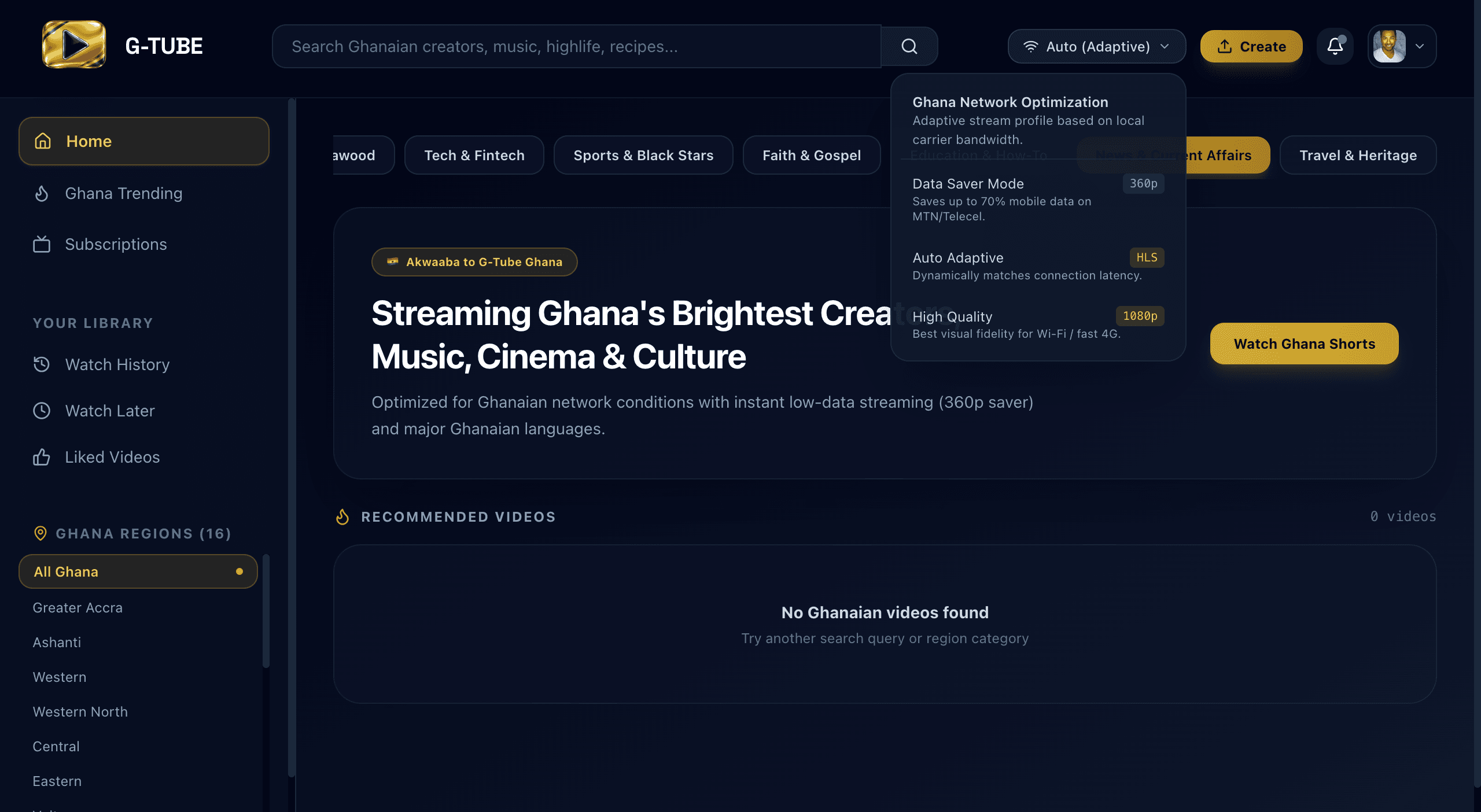
Screenshot synced from this project record.
Verified results and supporting evidence
external project link
G-Tube staging deployment
Current Vercel staging/demo deployment for the G-Tube application.
Open approved source →Current status
Development
Engineering insights
The project has reinforced three engineering principles: privileged administration must remain separate from consumer UI; staging/demo data must never be presented as live production telemetry; and external providers such as Supabase, Cloudflare Stream, Paystack and AI services must be treated as integration states until credentials, persistence, webhooks and end-to-end flows are genuinely connected and tested.
Acquire this application or request a similar build
This is a Frontier-owned product. You can open a commercial acquisition discussion for the existing application, or request a separate solution built around similar engineering capabilities.